auto-07p framework
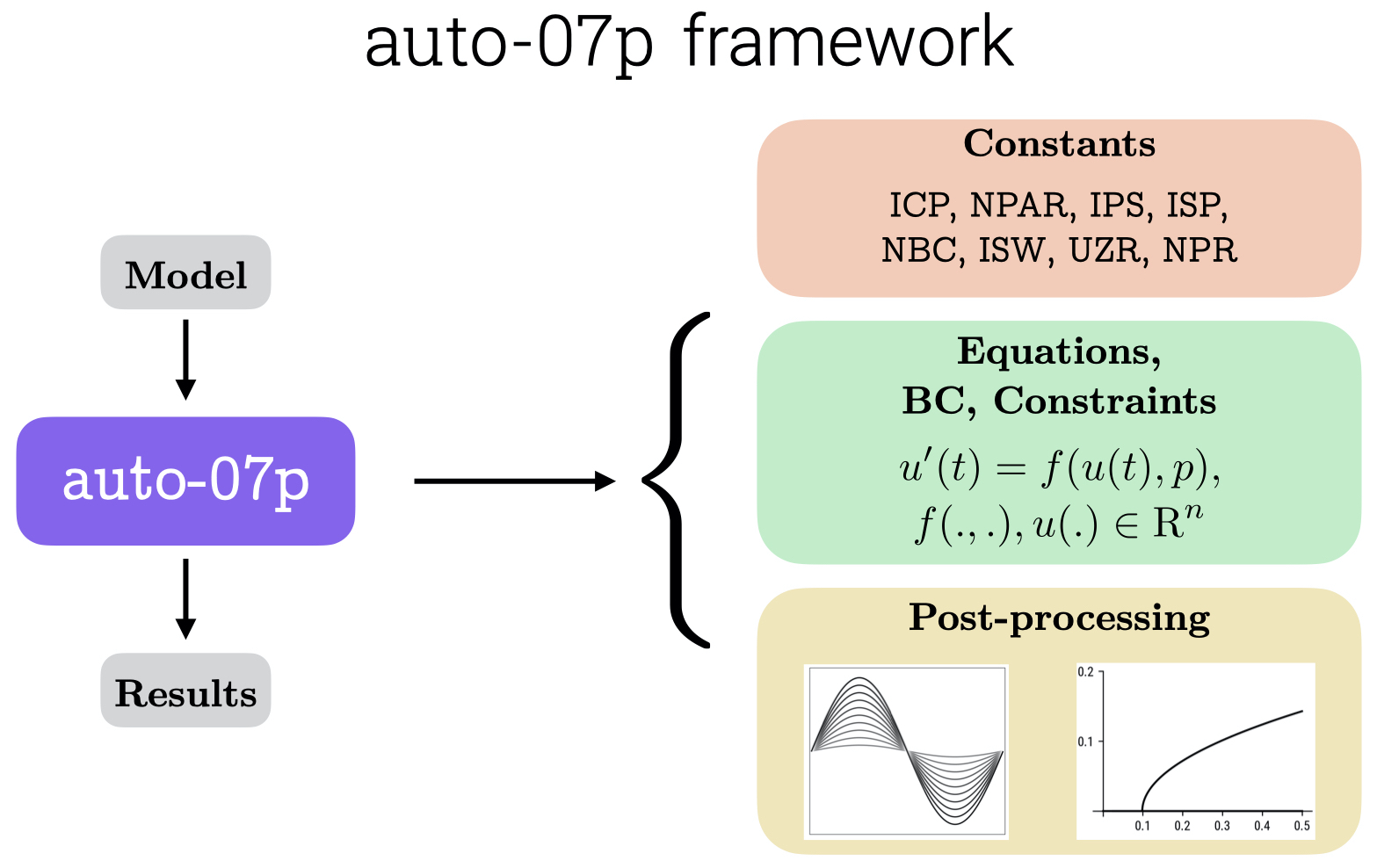
The framework that we use to solve elastic instability problems has 3 major steps.
To identify the model equations that describe the deformation field in elastic structure, derived either phenomenologically or from first principles. This is the part that captures the physics of the problem.
Using
auto-07pto solve the system with the appropriate boundary conditions and continue the solution along a physical parameter in the system to see if the morphology changes with this parameter.auto-07paccepts first-order differential equations of the form u'(t) = f(u(t), p), \quad f(.,.), u(.) \in \text{R}^n, where p are the parameters in the problem. If we have a higher-order system, we need to convert and represent it in this form.auto-07pfinds solutions to these equations (i.e. f(u(t),p)=0) and continues along different parameters p in the model. We then post-process the output files to understand the results.Of course, the last step is to interpret the results and compare with experiments if any. Then go back to step (i) if there is a mismatch.
The step I will be focusing on in these tutorials is (ii) where we assume that the equations are already available. We will extract the bifurcation diagram and plot the solution files.