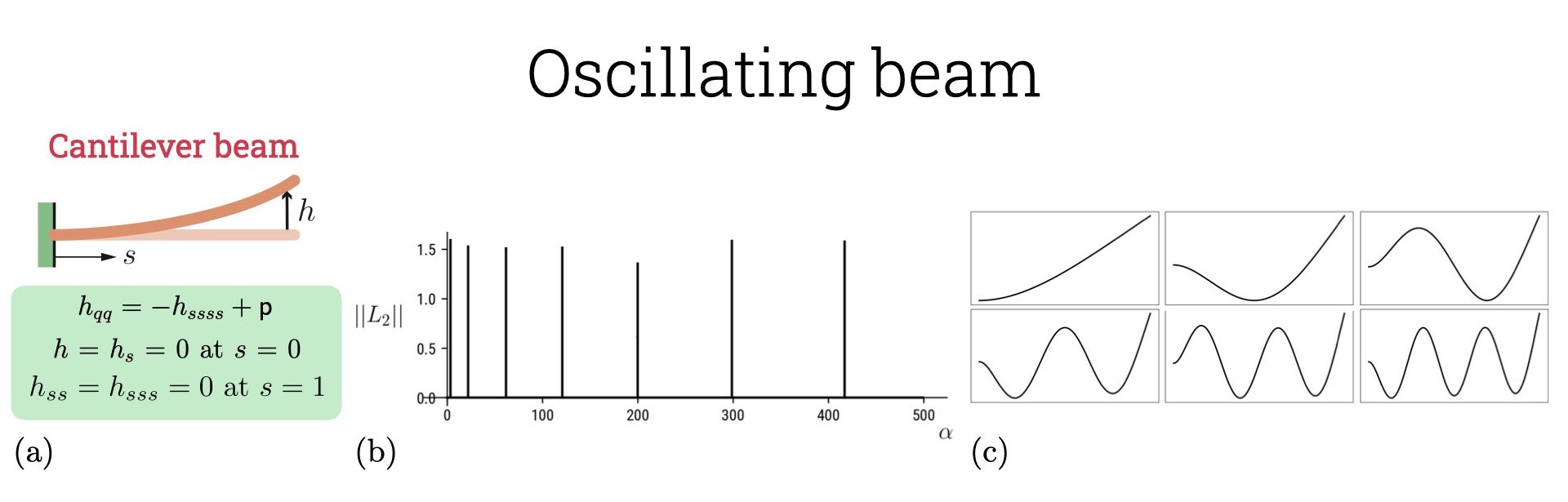
Oscillating beam
The small-deflection morphology of an elastic beam is governed by the Euler–Bernoulli equation: \[\alpha w_{tt} = - B w_{xxxx} + p.\] Here \(w(x)\) is the vertical displacement, \(\alpha\) is the mass per unit length, \(B = EI \sim E\xi^4\) is the bending modulus, \(E\) the Young's modulus, \(I\) the second moment of area, \(\xi\) the beam thickness, and \(p\) the body force per unit length.
Non-dimensionalising with beam length \(L\) as the length scale and \(T \sim (\alpha L^4/B)^{1/2}\) as the time scale gives \[h_{qq} = - h_{ssss} + \mathsf{p},\] where \(\mathsf{p} = (pL^3/B)\).
We solve two cases:
- Cantilever beam: \(h = h_s = 0\) at \(s=0\); \(h_{ss} = h_{sss} = 0\) at \(s=1\); \(\mathsf{p}=0\).
- Unsupported beam: \(h_{ss} = h_{sss} = 0\) at \(s=0,1\); \(\mathsf{p}=\beta\sin(2\pi s)\).
Substituting \(h(s,q) = \Re[\hat{h}(s)\,e^{i\omega q}]\) converts the PDE to the eigenvalue problem \[\omega^2 \hat{h} = \hat{h}_{ssss} - \hat{\mathsf{p}}.\]
For the cantilever, \(\omega\) is the continuation parameter. For the unsupported beam,
all boundary conditions are derivative conditions and do not uniquely select a solution.
We pin the solution via homotopy continuation by introducing a parameter \(\lambda\):
\[\omega^2 \hat{h} = \hat{h}_{ssss} - \hat{\mathsf{p}} + \lambda \hat{h}.\]
Starting at \(\lambda=1\) and continuing to \(\lambda=0\) pins the solution and allows
further continuation in \(\beta\). This homotopy technique is broadly useful.
Code is in
Tutorial3_EB.